Are clear aligners really invisible? Why crystal clear in the hand is not invisible on the teeth
- Sherif Kandil
- Jul 9
- 5 min read

Quick answer: A clear aligner that looks crystal clear in the hand is not automatically invisible on the teeth. Invisibility depends on how the surface manages light. A glossy finish throws one bright glare that the eye catches instantly. A finish with fine micro striations scatters light in many directions, so the aligner disappears in the mouth even if it looks slightly foggy in the hand.
KEY TAKEAWAYS
Clarity in the hand and invisibility in the mouth are two different optical properties.
Glossy surfaces create a specular highlight, the sharp glint that announces an aligner on the teeth.
Fine micro striations scatter light, which is why a slightly foggy aligner can be the most invisible one in the mouth.
The only test that matters is the mouth under normal light, never the desk.
K Line finishes aligners for the mouth, not for the hand.
Why does a crystal clear aligner still show on the teeth?
Because gloss creates glare, and glare is what the human eye notices first. A clear, perfectly glossy aligner reflects light in a single direction and produces one sharp, bright highlight. That glint is precisely what announces an aligner on the teeth, no matter how clear the plastic itself is.

Watch what happens when anyone picks up an aligner for the first time. A CEO evaluating a manufacturer, an orthodontist comparing suppliers, a patient opening the first box. Everyone does exactly the same thing. They hold it up to the light, turn it slowly, and judge it like a diamond. That test feels intuitive, and it is exactly backwards.
Over the years I have collected samples from dozens of aligner companies. I literally keep an aligner sample library at home. Different polymers, different finishes, all selling the same promise of total invisibility. The pattern never changes: how an aligner looks on a desk tells you almost nothing about how it looks on a patient.
What makes a clear aligner invisible in the mouth?
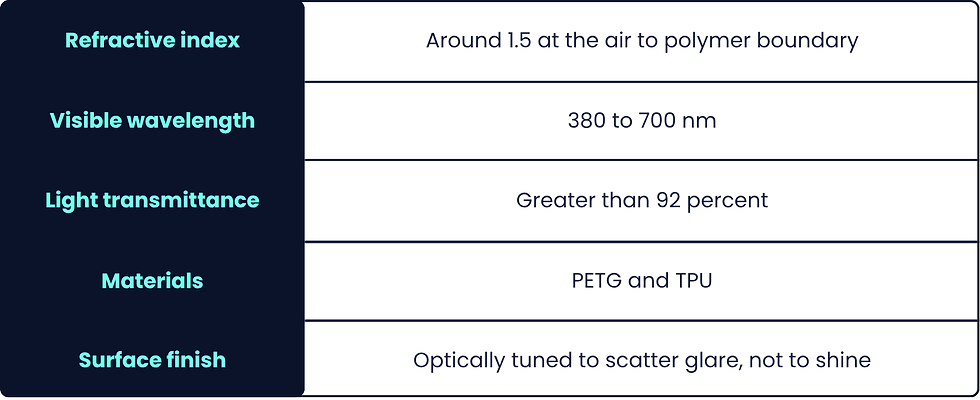
A surface that scatters light instead of reflecting it. When light meets an aligner, it slows at the boundary between air and polymer, at a refractive index of around 1.5. What happens next is decided entirely by the surface finish.
A surface with fine micro striations acts like a tiny relief map. Those lines scatter incoming light in hundreds of directions at once. No single reflection is strong enough to register; the glare collapses, and dispersion softens the edges of what remains. On the patient, the aligner disappears. In your hand, that same surface can look slightly foggy.

Is a foggy aligner worse than a glossy one?
No. In the mouth, a slightly foggy aligner is often the more invisible one. This is the paradox we see constantly. The aligner that looks flawlessly clear on the desk can be the most visible one in the mouth, and the one that looks a little foggy in the hand can be the one nobody notices. Even the most recognized name in the category gets knocked for looking foggy in the hand. Its patients still call it invisible.

The mouth, under normal light, is the only test that matters. The audience that counts is never holding the aligner. They are sitting across the table from your patient.
What should aligner brands tell their clients about transparency?
That desk clarity is the wrong test, and to say so before the first case ships. If you run an aligner brand, transparency complaints are rarely a quality problem. They are an expectation problem, and expectation problems are far cheaper to fix. A client who understands the optics before the first case ships never opens that ticket. One honest paragraph in your onboarding does the work of a hundred support replies.
It also changes how you compete. When a rival's sales deck leans on how clear their aligner looks on a desk, you have the better answer: clarity on a desk is a showroom trick. Invisibility in the mouth is engineering.
How should orthodontists handle transparency concerns in the chair?
Show the aligner in the mirror, not in the hand. When a patient worries about being seen, do not hand them the aligner. Seat it, hand them a mirror, and let them look under normal room light. The in-hand view invites inspection of clarity. The in-mouth view ends the conversation, because the glare is gone and there is nothing left to point at.
“After years of collecting aligner samples, I can tell you the test everyone uses is the wrong one. Crystal clear in your hand does not mean invisible on the teeth. What makes an aligner disappear is a surface that scatters glare, not one that shines on a desk. Less glare beats more clarity. At K Line we finish for the mouth, not for the hand.” - Dr. Sherif Kandil, CEO and orthodontist

Clear aligner optics at a glance

Frequently asked questions (FAQ)
Are clear aligners completely invisible?
No aligner is completely invisible under every condition. An aligner reads as invisible when its surface scatters light instead of reflecting it in one bright glint. Under normal social distance and normal light, a well finished aligner is not noticeable to the people around the patient.
Why does my clear aligner look shiny in photos?
Camera flashes and direct light sources create a strong specular highlight on glossy surfaces. That single bright reflection is what shows up in photos. A finish that scatters light in many directions produces no single strong reflection, so it stays unremarkable on camera and in person.
Does a foggy looking aligner mean lower quality?
No. A slight fog in the hand is often the signature of a surface tuned with fine micro striations that scatter light. That same scattering is exactly what makes the aligner disappear on the teeth. Judging quality by desk clarity is using the wrong test.
What are clear aligners made of?
Most clear aligners are made of PETG or TPU polymers with light transmittance above 92 percent and a refractive index of around 1.5. The material transmits almost all visible light. Visibility on the teeth is decided mainly by the surface finish, not by the material's clarity.
How can I check how invisible an aligner really is?
Seat the aligner on the teeth and look in a mirror under normal room light, or ask someone at conversation distance whether they notice it. Inspecting the aligner in your hand at close range tests clarity, which is not the property that matters in life.
Do patients actually notice aligner transparency?
In clinical practice, far less than marketing suggests. The transparency worry usually lives in brand messaging and in the unboxing moment, not in the chair. Patients who view their seated aligner in a mirror under normal light typically stop worrying about being seen.
About the Author
Dr. Sherif Kandil is an orthodontist and the CEO and founder of K Line Europe GmbH, the world's leading clear aligner private label and contract manufacturing platform, headquartered in Düsseldorf, Germany.
The transparency worry lives in marketing, not in the chair. The science is settled and it is on your side. An aligner is invisible when it stops throwing glare, not when it looks like glass on a desk.


Comments