The Infrastructure Behind a Private Label Aligner Brand

Why the manufacturer behind your brand shapes everything that comes after.
Private label clear aligner manufacturing has quietly become one of the fastest-growing models in orthodontics. Dental groups, orthodontic practices, labs, and DSOs are building their own aligner brands instead of licensing someone else’s. The reasons are well documented: better margins, brand equity, control over the patient experience, and the strategic freedom to design a clinical program that fits the practice rather than the other way around.
But there is a quieter truth underneath this growth: the private label model itself is only as strong as the manufacturer behind it.
“Private label does not commoditize the category by itself. Bad private label does.”
- Healthcare strategist Agustín Sánchez Durán
That distinction is the most important question facing every clinician, DSO leader, and lab owner currently exploring this path. Because the success of a private label aligner brand has almost nothing to do with the brand itself, and almost everything to do with the manufacturing infrastructure standing behind it.
The promise and the trap
The promise of private label is real. A clinician with strong patient relationships and a clear clinical philosophy can launch an aligner brand without buying a 3D printer, hiring technicians, navigating multi-jurisdictional regulatory clearance, or building a manufacturing operation alongside running a practice. The manufacturer handles production, regulatory compliance, packaging, and shipping at scale. The clinician handles what only they can do: clinical judgment, patient relationships, brand identity, and growth.
When the model works, it creates clinician-owned brands with stronger economics and more coherent patient experiences than legacy alternatives.
When the model fails, it usually fails the same way: the manufacturer behind the brand was not built to support it.
What a weak manufacturing partner actually looks like

A weak private label manufacturer can appear adequate at first glance. Cases are produced. Aligners arrive. Patients receive treatment. The visible artifact looks like everyone else’s.
The problems surface later, and they compound:
Inconsistent quality across batches. Aligners that fit beautifully in one shipment and poorly in the next. The clinician absorbs the cost in chair time, patient frustration, and reputation damage.
Unclear or incomplete regulatory coverage. Manufacturers that hold one certification but lack the full stack required to operate cleanly across multiple jurisdictions. The risk surfaces during audits, during patient incidents, or during expansion into new markets.
No real clinical support. Treatment planning that returns slow or unhelpful results. No infrastructure to support refinements. No escalation path when a complex case needs human review.
Refining economics that destroy profitability. Cases that require multiple revisions, additional impressions, and repeated reviews quietly turn profitable treatments into break-even ones. The price per tray looks cheap. The price per completed case is not.
No scale resilience. Manufacturers with single-location production who cannot absorb supply chain disruption, regulatory changes, or rapid demand shifts. A growing brand outgrows them in a year.
This is the private-label version that gives the model a difficult reputation. It is also the version most new entrants encounter first, because cheap OEM capacity is the easiest version to find and the hardest to evaluate without experience.
What a serious manufacturing partner looks like
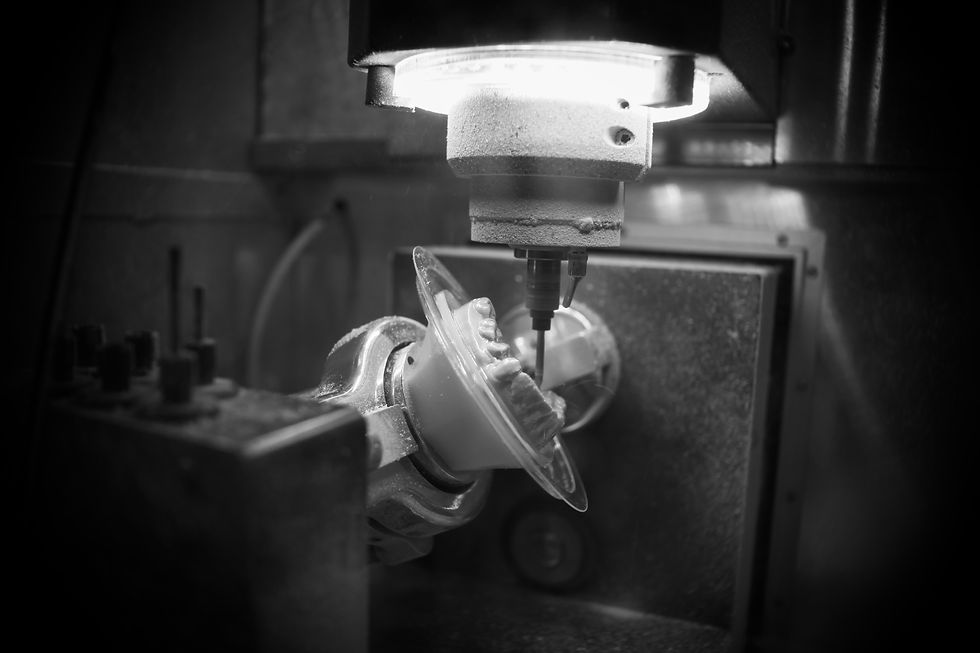
The serious private label manufacturers operate at a different standard. The visible product is similar. The infrastructure underneath is not.
Serious private label means manufacturing at meaningful scale. Production volumes that prove the operation has the rigor to maintain consistency across thousands of cases per day, not hundreds per week.
It means full regulatory coverage across the jurisdictions a growing brand will need to operate in. FDA clearance for the US, CE and MDR for Europe, MHRA for the UK, TGA for Australia, and ISO 13485 for international quality systems. Not as marketing claims but as audited standards.
It means production discipline that holds across geographies. Multi-factory networks operating to the same specifications, so a brand can serve patients in different markets without compromising consistency.
It means clinical infrastructure that supports the clinician, not the other way around. Treatment planning that returns quickly and accurately. Refinement support that does not require the clinician to absorb every operational problem.
The most expensive line item in any aligner program is not the tray. It is the rework, the additional impressions, the multiple revisions, and the chair time spent fixing what should have been right the first time.
It means scale resilience. Multiple facilities across multiple regions, so no single point of failure can compromise a partner’s growth.
Why this matters now
For the orthodontists, labs, DSOs, and dental groups currently considering a private label aligner brand, the choice of manufacturing partner is not a procurement decision. It is a strategic decision.
A weak manufacturer locks a growing brand into rework cycles, capacity ceilings, regulatory exposure, and quality variability. A strong manufacturer becomes the operational foundation that lets the brand grow without those constraints.
The market is moving in this direction, whether individual brands acknowledge it or not. Patients increasingly expect predictable outcomes. Regulators increasingly expect documented quality systems. Multi-location dental groups increasingly expect consistency across every site they operate. The brands that can deliver those expectations will compound. The ones that cannot will struggle to differentiate, regardless of how strong their clinical reputation is.
What scale actually means in private label aligner manufacturing
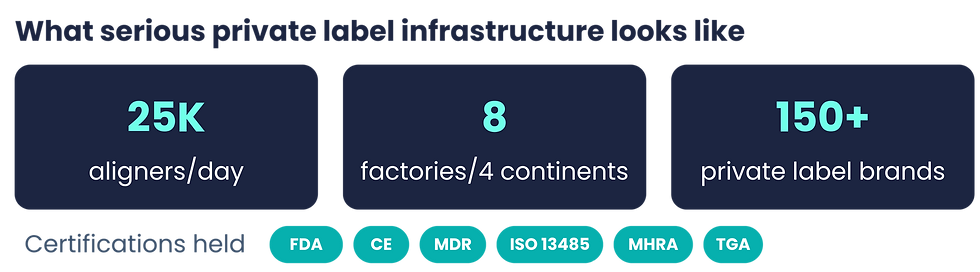
K Line produces 25,000 aligners per day across 8 factories on 4 continents, holds FDA, CE, MDR, ISO 13485, MHRA, and TGA certifications, and manufactures for more than 150 private label brands worldwide. The infrastructure exists. The standards are documented. The model has been operating at scale for over a decade.
This is not the only model worth considering. But it is a reference point for what serious private label infrastructure actually looks like, and it is the standard new entrants should be benchmarking against when they evaluate a manufacturing partner.
The decision worth making slowly
The decision to launch a private label aligner brand is one of the most strategic moves a dental practice, lab, or DSO can make in 2026. The decision of who to launch it with is even more strategic.
A brand can be redesigned. A logo can be replaced. A patient experience can be refined. But the manufacturer behind a private label aligner program shapes the economics, the clinical outcomes, the regulatory posture, and the growth ceiling of the entire venture.
Choose well. The manufacturer behind your brand shapes everything that comes after.
Ready to build on real infrastructure?
If you’re exploring private label aligners, the infrastructure question comes before the brand question. The economics, the clinical outcomes, and the growth ceiling all trace back to the same decision: who manufactures your product?
K Line works with practices, labs, and DSOs at every stage of private label development:
✔ Custom brand design from logo to packaging, built around your clinical positioning.
✔ Manufacturing precision at 25,000 aligners/day across 8 factories — with the regulatory coverage to match.
✔ Clinical responsiveness that reduces refinement cycles and protects your case economics.
If you’re benchmarking partners or just starting to ask the right questions, contact us to talk through what the right manufacturing partnership looks like for your model.


Comments