20 million orthodontic cases per year: What the numbers really reveal

A vision of Dr. Sherif Kandil, CEO of K Line Europe
Every year, around 20 million new orthodontic cases start worldwide. That number on its own is massive. But what really becomes interesting is what happens when you zoom in and start pulling this number apart.
The patterns underneath tell a story that, in my view, many people in our industry are still underestimating.
I recently spent some time mapping the orthodontic landscape and analyzing how those 20 million cases are distributed. Some of the insights challenged a few of my own assumptions as well. So let me walk you through what I see, what it means, and where I think the industry may be heading.
The 75/25 split that defines the industry
Let’s begin with the broad picture.
Traditional brackets still account for roughly 75% of orthodontic treatments globally, while clear aligners represent around 25%.
Out of those 20 million annual cases, that translates to approximately:
15 million cases treated with brackets
5 million cases treated with aligners

Considering the amount of attention clear aligners have received over the past decade, that ratio may surprise some people. The innovation, investment, and marketing around aligners often give the impression that they have already taken over the market. In reality, they are still in a strong growth phase rather than a dominant position.
And there is another interesting observation. From conversations across the industry, bracket sales are also increasing in several markets. Awareness of orthodontic treatment is expanding globally, adult patients are entering the category in larger numbers, and new markets are opening.
In other words, the overall orthodontic market is growing as a whole, rather than one technology simply replacing the other.
Inside the Aligner Segment
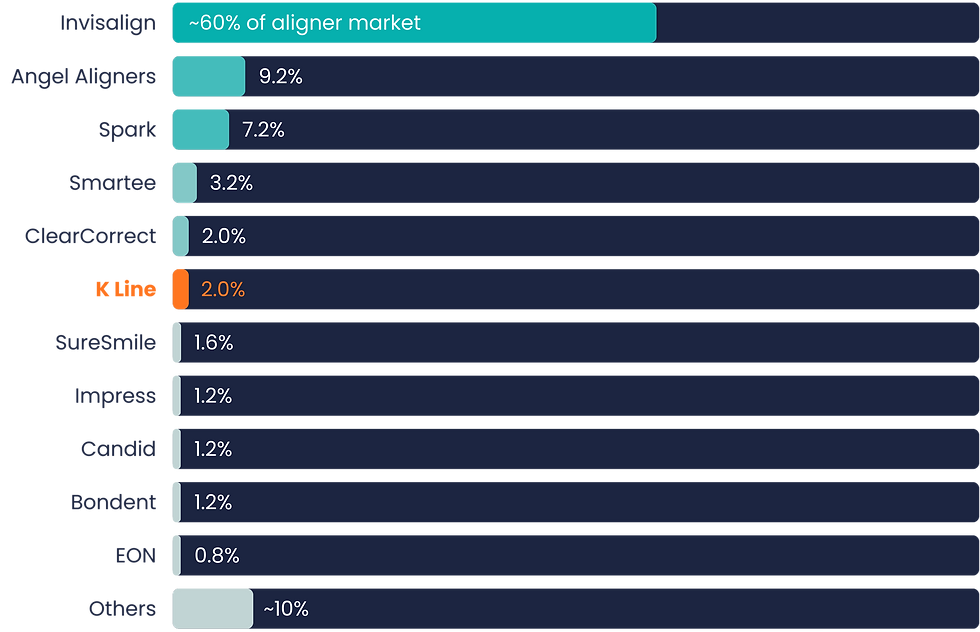
When you isolate the aligner market itself, a very interesting pattern appears.
One company sits far ahead of everyone else, followed by a long tail of smaller players.
Invisalign represents approximately 13% of the total orthodontic market, which translates to around 52% of the global aligner segment. That means that in a category with dozens of brands competing worldwide, one company still holds more than half of the space.
The second largest player, Angel Aligners, sits at roughly 2.3% of the total orthodontic market.
In simple terms, Invisalign is currently more than five times larger than its closest competitor.
After that, the numbers drop quickly.
Brands such as Spark, Smartee, ClearCorrect, SureSmile, Impress, Candid, and Bondent occupy smaller portions of the market, typically between 0.3% and 2% depending on geography and methodology.
Below that sits an even longer list of emerging players holding fractions of a percent.
One observation stood out clearly when looking at the data:
If you combine the entire long tail of aligner brands, their total share roughly equals what Invisalign holds alone.
That level of concentration is remarkable in what many people describe as a fragmented market.
The Missing Middle
One of the most interesting structural patterns in the aligner industry is something I like to call “the missing middle.”
In most maturing industries, a recognizable structure eventually appears:
a clear market leader
two or three strong challengers
a long tail of niche players
You can see this pattern in smartphones, cars, and consumer electronics.
In clear aligners, that middle layer barely exists.
The jump from a leader controlling over half the market to companies operating in the single digits is unusually large. There are very few brands occupying the 20% to 30% challenger position that we often see in mature industries.
This gap creates one of the most interesting strategic questions in orthodontics today.

Will one or several companies break out of the long tail and establish themselves as credible second tier leaders?
Or will the market consolidate further around the dominant player?
Whoever manages to occupy that middle space could reshape the competitive landscape of the aligner industry.
The geographic layer of the story

Another pattern becomes visible when you look at where aligner companies originate.
Several major players still have strong regional roots.
Angel Aligners and Smartee have deep foundations in China and Asia Pacific markets.
Impress built early traction in Europe through a direct to consumer model.
SouSmile has been growing out of Brazil and Latin America.
Candid emerged from the US direct to consumer wave before transitioning toward professional channels.
This suggests that the aligner market is still in the process of becoming truly global.
Most companies first established strong positions in their home regions before expanding internationally. In contrast, Invisalign invested early in global infrastructure and now operates in more than 100 countries worldwide, giving it a substantial head start in brand recognition, clinician training, and supply chain depth.
That global footprint compounds over time and becomes difficult for challengers to replicate quickly.
What the Bracket Market teaches us
One mistake I sometimes see in discussions about orthodontics is assuming that brackets will slowly fade away as aligners grow.
The reality is more nuanced. Bracket manufacturers continue to innovate.
Self ligating brackets now represent a large portion of the bracket segment.
Ceramic brackets continue to grow steadily.
Companies such as LightForce are developing fully customized 3D printed brackets supported by digital workflows and AI assisted treatment planning.
In other words, brackets are evolving as well.
For aligners to continue expanding their share, they will need to consistently demonstrate:
better patient experience
efficient clinical workflows
strong treatment outcomes
attractive economics for practices
The competition between treatment modalities is still very active.
Where the industry may be heading
Several trends seem likely to shape the next decade of orthodontics.
Consolidation within the aligner industry appears almost inevitable. With many smaller players competing in a fragmented market, acquisitions and strategic partnerships will likely increase.
The aligner share of the orthodontic market will probably continue growing, though perhaps more gradually than the most optimistic forecasts suggest. Over the next decade it would not be surprising to see aligners approach 35% to 40% of global treatments, driven by adult orthodontics, improved digital workflows, and expanding access in emerging markets.
But the development I am watching most closely is the race to fill that missing middle. Which companies manage to scale beyond the long tail and become credible global challengers will shape the competitive structure of this industry for years to come.
One thing is becoming increasingly clear: as the aligner ecosystem grows, the companies that succeed may not necessarily be those who try to build every piece internally. The real advantage may lie in assembling the right combination of manufacturing, technology, and clinical expertise through strong partnerships.
In fast growing industries, the strongest ecosystems often win.
A note on the data
Some of the figures referenced in this article are based on publicly available industry reports, market analyses, and aggregated estimates derived from multiple sources.
Market share numbers can vary depending on methodology, geography, and reporting period. The objective of this analysis is not to claim absolute precision but to highlight structural patterns shaping the orthodontic market today.
If you work closely with market data or have additional insights from within the industry, I would welcome the discussion. A clearer understanding of the numbers ultimately benefits everyone involved in orthodontics.


Comments